

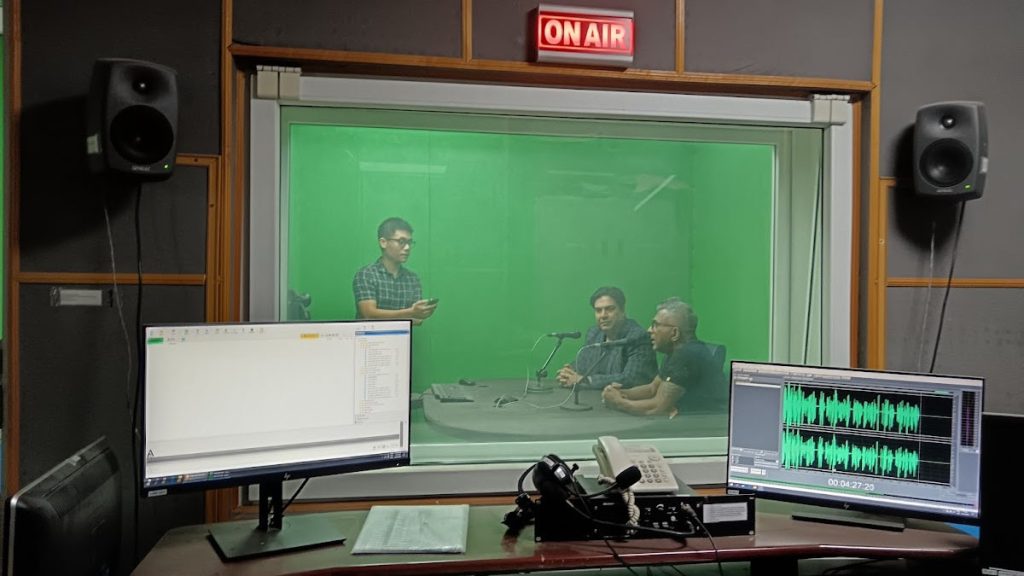
When I sat down for an interview at Voice of Vietnam in Hanoi with renowned Malaysian broadcaster Mr. Seelan Paul, I expected a conversation about broadcasting trends. What I got instead was a question that cuts to the heart of everything media leaders debate behind closed doors , but rarely say out loud in public.
The question was direct: If podcasts, streaming, and social platforms are everywhere — what is the point of terrestrial radio?
It is a question built on an assumption: that reach equals relevance.
It doesn’t.
And it is precisely this assumption that media leaders, policymakers, and communications strategists need to challenge, urgently and clearly.

The False Narrative: Reach Does Not Equal Relevance
For decades, conversations about the future of broadcasting have been dominated by a single metric: audience reach. The emergence of podcasts, music streaming platforms, social media audio, and on-demand content has created a widespread belief that terrestrial radio — the kind that travels through the air without internet dependency, is on its way out.
This belief is not just premature. It is strategically dangerous.
High digital reach does not guarantee communication resilience. A platform that requires a smartphone, a data plan, and an operational internet infrastructure is only as reliable as the weakest link in that chain. And those chains break, often at the worst possible moments.
Terrestrial Radio as a National Security Asset
Consider what governments have invested in terrestrial broadcasting infrastructure over decades. These are not just radio towers. They are national communication systems — designed and built to function independently of commercial networks, international cables, and digital platforms.
We have seen it repeatedly. When internet networks collapse due to natural disasters, when apps go silent because servers go down, when data lines fail during political instability or armed conflict — radio stays on. Terrestrial signals become lifelines. In moments of crisis, public radio has remained the most reliable channel for:
- Managing mass public communication
- Countering disinformation and misinformation
- Sustaining citizen trust in institutions
- Coordinating emergency response and evacuation
- Reaching populations without smartphones or data access
The infrastructure that governments built is not “old.” It is resilient. And resilience, in an increasingly fragile digital world, is one of the most valuable strategic assets a country can hold.
World Radio Day 2026: Radio and AI, The Real Debate
This year’s World Radio Day theme, “Radio and AI,” arrives at a pivotal moment. AI is already reshaping how content is created, curated, and distributed across every media platform. Broadcasting is no exception.
But there is a risk that the conversation gets reduced to a single, surface-level question: Can AI generate radio content?
Of course it can. That is the easy part. And the least interesting part.
The real debate is more substantial, and broadcasters need to engage with it seriously:
- Will traditional broadcasters use AI merely to automate content production — or to fundamentally rethink their editorial workflows?
- Will AI be used to reduce energy consumption and improve the environmental footprint of transmission systems?
- Can AI strengthen governance, transparency, and accountability within public broadcasters?
- How can AI help modernize aging transmission infrastructure while maintaining emergency broadcast capability?
AI should help radio become smarter, leaner, and more accountable. It should not replace radio’s core responsibility — its obligation to serve the public, especially those most marginalized.
What AI in Broadcasting Should Actually Look Like
AI governance in broadcasting is not a technology problem. It is a leadership problem. The tools exist. What is lacking, in too many organizations, is the strategic clarity and institutional will to deploy them responsibly.
Here is what meaningful AI integration in terrestrial radio actually looks like:
- Workflow optimization: Using AI to streamline production, scheduling, and archiving without reducing editorial quality
- Energy efficiency: AI-assisted management of transmission infrastructure to reduce power consumption and carbon footprint
- Audience intelligence: Ethical data analytics that help public broadcasters understand and serve diverse communities better
- Governance frameworks: AI-supported monitoring and compliance systems that strengthen editorial independence and accountability
- Accessibility: AI-powered transcription, translation, and captioning to extend reach to underserved and differently-abled audiences
None of this replaces the journalist, the broadcaster, or the public service mission. It enhances it. The distinction matters enormously.
The Hanoi Conversation: A Reflection from the Field
The interview at Voice of Vietnam was produced by Ms. Tang Hai Ha, whose thoughtful approach to the conversation gave us the space to explore these ideas without the usual constraints of headline-driven broadcast media. Sitting across from Mr. Seelan Paul — a respected figure in Malaysian and regional broadcasting — the discussion went beyond format and frequency. We talked about purpose.
What does radio owe its audience?
In an age when any individual with a smartphone and a microphone can reach a global audience, public broadcasters must be able to answer this question with clarity and conviction. The answer, I believe, is this: radio owes its audience reliability, integrity, and presence — especially in the moments when everything else goes dark.
That is not a nostalgic argument for analog technology. It is a strategic argument for infrastructure resilience, editorial independence, and public accountability in the digital age.
Radio Carries History. But More Than That, It Carries Duty.
Broadcasting history is inseparable from moments of crisis. Wartime broadcasts. Post-disaster information campaigns. Election results announced to communities with no other means of receiving news. Emergency alerts reaching farmers, fishermen, and remote communities hours before any internet signal reaches them.
This is not sentiment. This is function.
And as AI begins to transform the media landscape — introducing synthetic voices, automated curation, and algorithmic programming — the duty that terrestrial radio carries becomes more important, not less. Someone must remain accountable to the public. Someone must be required to tell the truth, to explain the crisis, to speak calmly when the world is not calm.
That responsibility cannot be offloaded to an algorithm.
What Broadcasters and Policymakers Must Do Now
If there is a single message I would leave with broadcasters, media regulators, and government communications strategists, it is this: do not allow the conversation about digital transformation to become an argument for abandoning terrestrial infrastructure.
Instead, do the harder work:
- Invest in modernizing terrestrial broadcast infrastructure alongside digital expansion
- Develop AI governance frameworks specific to public broadcasting contexts
- Protect the editorial independence of public broadcasters from political and commercial pressure
- Mandate emergency broadcast capability as a non-negotiable element of national communications policy
- Train the next generation of broadcasters to be fluent in both AI tools and journalism ethics
The future of broadcasting is not a choice between terrestrial and digital. It is the integration of both — with clear governance, strategic intent, and an unwavering commitment to public service.
A Note of Gratitude
I want to extend my sincere thanks to Ms. Tang Hai Ha at Voice of Vietnam for the invitation and for producing this interview with such professionalism and care. And to Mr. Seelan Paul — thank you for asking the question that needed to be asked, and for the conversation that followed.
Happy World Radio Day.
About the Author
Nabeel Tirmazi is a media consultant, broadcaster, trainer, and AI governance specialist with over 25 years of experience across Asia-Pacific, South Asia, and the MENA region. He has worked with UNESCO, AIBD, and a range of broadcasting development organizations on media strategy, journalism training, and digital transformation. He is based in Kuala Lumpur, Malaysia.

Frequently Asked Questions
- Is terrestrial radio still relevant in the age of podcasts and streaming?
Yes. Terrestrial radio remains a critical strategic asset, not a relic. While podcasts and streaming offer digital reach, they depend entirely on internet connectivity. Terrestrial radio operates independently of digital infrastructure, making it irreplaceable during natural disasters, power outages, political crises, and network failures. Reach does not equal relevance — and resilience is a strategic necessity. - How should broadcasters approach AI integration in radio?
AI in broadcasting should go beyond automating content. Responsible AI integration means rethinking editorial workflows, improving energy efficiency of transmission systems, strengthening governance and editorial accountability, expanding accessibility through AI-powered transcription and translation, and using data ethically to serve diverse audiences. AI is a tool to make radio smarter and more accountable — not to replace its public service mandate. - What is the theme of World Radio Day 2026?
The theme of World Radio Day 2026 is "Radio and AI." It marks a pivotal moment in broadcasting history where artificial intelligence is actively reshaping content creation, distribution, and audience engagement. The central question for broadcasters is not whether AI will change radio, but how to deploy it responsibly — in ways that strengthen governance, efficiency, and public service rather than simply automating output. - Why is terrestrial radio important during emergencies and crises?
Terrestrial radio is uniquely resilient because it does not depend on internet connectivity, smartphones, or commercial servers. When natural disasters strike, when power grids fail partially, or during political crises that disrupt digital networks, terrestrial broadcasting signals continue to reach communities. This makes it essential for emergency communication, disaster management, public health messaging, and countering misinformation in times of crisis.
Quick Summary
In this World Radio Day 2026 article, media consultant and AI governance specialist Nabeel Tirmazi argues that terrestrial radio is not a relic — it is strategic national infrastructure. Drawing from an interview at Voice of Vietnam with Malaysian broadcaster Seelan Paul, Tirmazi challenges the assumption that reach equals relevance and explains why radio's independence from internet infrastructure makes it irreplaceable during crises. On the theme of "Radio and AI," he calls on broadcasters to move beyond AI content generation and instead focus on AI governance frameworks, energy efficiency, editorial accountability, and workflow modernization. The article includes actionable recommendations for broadcasters and policymakers, with a clear argument that the future of broadcasting requires the integration of both terrestrial and digital systems under responsible governance.