

Journalists are trained to run toward difficult stories. Disasters, violence, road accidents, displacement, harassment, political unrest, and human suffering often become part of their daily professional reality. They arrive at the scene, ask questions, record pain, verify facts, write the story, and move on to the next assignment.
But the human mind does not always move on that quickly.

AfterCopy is designed for the emotional space that appears after the report is filed. It is a journaling and reflection app for journalists who cover distressing assignments and need a private, structured way to process what they have witnessed. Its tagline says it clearly: “For the weight journalists carry after the story.”
Link to app: https://nabeeltirmazi.github.io/aftercopy-app/
This matters because journalists often absorb difficult material without proper recovery time. They may interview grieving families, watch disturbing footage, report from disaster zones, face online abuse, or work under pressure from editors, deadlines, and public scrutiny. Female journalists often carry additional layers of risk, including gender-based harassment, threats, unsafe field conditions, online abuse, and the expectation to remain composed even when the assignment has affected them deeply.
A generic wellness app cannot fully understand this context. A journalist does not only feel “stressed.” She may be carrying images from a crash site, the voice of a survivor, the fear of being followed after a field assignment, or the emotional strain of reporting on violence against women. AfterCopy gives that experience a dedicated structure.
The app can include guided journaling prompts, post-assignment reflection, burnout self-checks, 24-hour and 72-hour emotional check-ins, grounding tools, private summaries, and AI-assisted reflection prompts. The purpose is not to diagnose or replace therapy. The purpose is to help journalists notice what they are carrying before it becomes emotional exhaustion, withdrawal, numbness, or burnout.
This framework also supports newsroom professionalism. Mental wellness is not separate from journalistic performance. A reporter who is emotionally overwhelmed may struggle with judgment, tone, concentration, source sensitivity, and ethical decision-making. The toolkit shared for journalists covering trauma and crisis already highlights preparation, buddy check-ins, grounding, digital detachment, post-assignment debriefing, journaling, and recognizing signs such as sleep problems, detachment, restlessness, and emotional strain.
Media outlets need to be sensitized because many newsrooms still treat distress as a private weakness instead of a workplace reality. Editors may assign traumatic stories without preparing reporters, checking on them afterward, or offering safe debriefing spaces. This silence is especially harmful for female journalists, who may already feel pressure to prove toughness in male-dominated spaces.
A responsible newsroom should ask basic questions. Was the reporter briefed before the assignment? Was there a buddy system? Was a debrief offered? Was the journalist given time before reviewing graphic footage? Is there a confidential support pathway? Are female journalists protected from online and field-based harassment?
AfterCopy can become more than an app. It can become a practical wellness framework for media outlets, journalism schools, NGOs, and safety trainers. It helps create a culture where emotional recovery is treated as part of the reporting process.
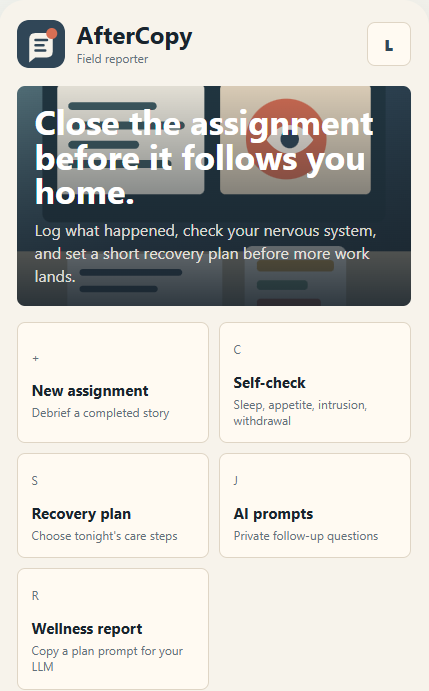
AfterCopy is simple to use. Once a difficult assignment ends, the journalist opens the app, chooses the type of story she covered, and begins a private guided reflection. The app asks what happened, what stayed with her, how she feels physically and emotionally, and whether she needs support. She can write freely, use structured prompts, complete a burnout self-check, and receive gentle AI-assisted reflection questions. The app can also remind her to check in again after 24 hours or 72 hours, because distress often appears after the deadline has passed. Her entries remain private unless she chooses to export or share them.
Does AfterCopy replace therapy or counselling?
No. AfterCopy does not diagnose or treat mental health conditions. It supports emotional awareness, reflection, and early recognition of distress and can sit alongside therapy, peer support, or organizational services.
How is AfterCopy different from other journaling or wellness apps?
AfterCopy is designed around the specific realities of journalism, including exposure to trauma, ethical dilemmas, deadline pressure, online abuse, and newsroom culture. Its prompts, check‑ins, and language reflect that professional context instead of offering generic stress tips.
Can newsrooms or journalism schools integrate AfterCopy into their policies or training?
Yes. AfterCopy can complement safety guidelines, trauma‑aware reporting workshops, and psychosocial support frameworks by giving journalists a concrete tool to use before, during, and after difficult assignments.
What happens to the reflections journalists write in AfterCopy?
Entries remain private unless the journalist chooses to export or share them with a supervisor, counsellor, or trusted colleague. The app’s role is to create a safe space, not a monitoring system.
Moving forward
Journalists tell some of society’s hardest stories. They deserve tools that help them return to themselves after telling them. AfterCopy is one step toward a media ecosystem where emotional recovery is recognized as part of ethical, responsible journalism, not a sign of fragility.
If you are a journalist, editor, or journalism educator interested in piloting AfterCopy or integrating it into your training and safety work, you can reach out to explore collaboration and early testing.
Frequently Asked Questions
- Who is AfterCopy for?
AfterCopy is for journalists, photojournalists, editors, and other media professionals who regularly cover distressing, traumatic, or emotionally heavy stories and want a private way to process them after the assignment ends. - Does AfterCopy replace therapy or counselling?
No. AfterCopy does not diagnose or treat mental health conditions. It supports emotional awareness, reflection, and early recognition of distress and can sit alongside therapy, peer support, or organizational services. - How is AfterCopy different from other journaling or wellness apps?
AfterCopy is designed around the specific realities of journalism, including exposure to trauma, ethical dilemmas, deadline pressure, online abuse, and newsroom culture. Its prompts, check‑ins, and language reflect that professional context instead of offering generic stress tips. - Can newsrooms or journalism schools integrate AfterCopy into their policies or training?
Yes. AfterCopy can complement safety guidelines, trauma‑aware reporting workshops, and psychosocial support frameworks by giving journalists a concrete tool to use before, during, and after difficult assignments. - What happens to the reflections journalists write in AfterCopy?
Entries remain private unless the journalist chooses to export or share them with a supervisor, counsellor, or trusted colleague. The app’s role is to create a safe space, not a monitoring system.
Quick Summary
AfterCopy is a private journaling and reflection app designed for journalists who regularly cover traumatic, distressing, or emotionally heavy stories. It addresses a critical gap in the media industry: the emotional space between filing a story and moving on to the next assignment, where unprocessed distress, vicarious trauma, and burnout often take root. Journalists — particularly female journalists — face unique emotional risks including exposure to graphic content, gender-based harassment, online abuse, ethical dilemmas, and newsroom cultures that rarely acknowledge emotional impact. Generic wellness apps do not address these realities. AfterCopy does, through guided journaling prompts, post-assignment check-ins, burnout self-assessments, grounding tools, and AI-assisted reflection questions — all in a confidential environment. AfterCopy is not a replacement for therapy or organizational support. It is a structured, trauma-aware tool that helps journalists recognize signs of distress early, build sustainable habits of emotional recovery, and maintain the clarity, accuracy, and empathy that good journalism requires. It is also a practical framework for newsrooms, journalism schools, NGOs, and safety trainers who want to integrate emotional wellbeing into editorial workflows, training programs, and psychosocial support systems. AfterCopy was developed by Nabeel Tirmazi, a media consultant and AI governance advisor with over 25 years of experience training journalists and broadcasters across South Asia and Southeast Asia.