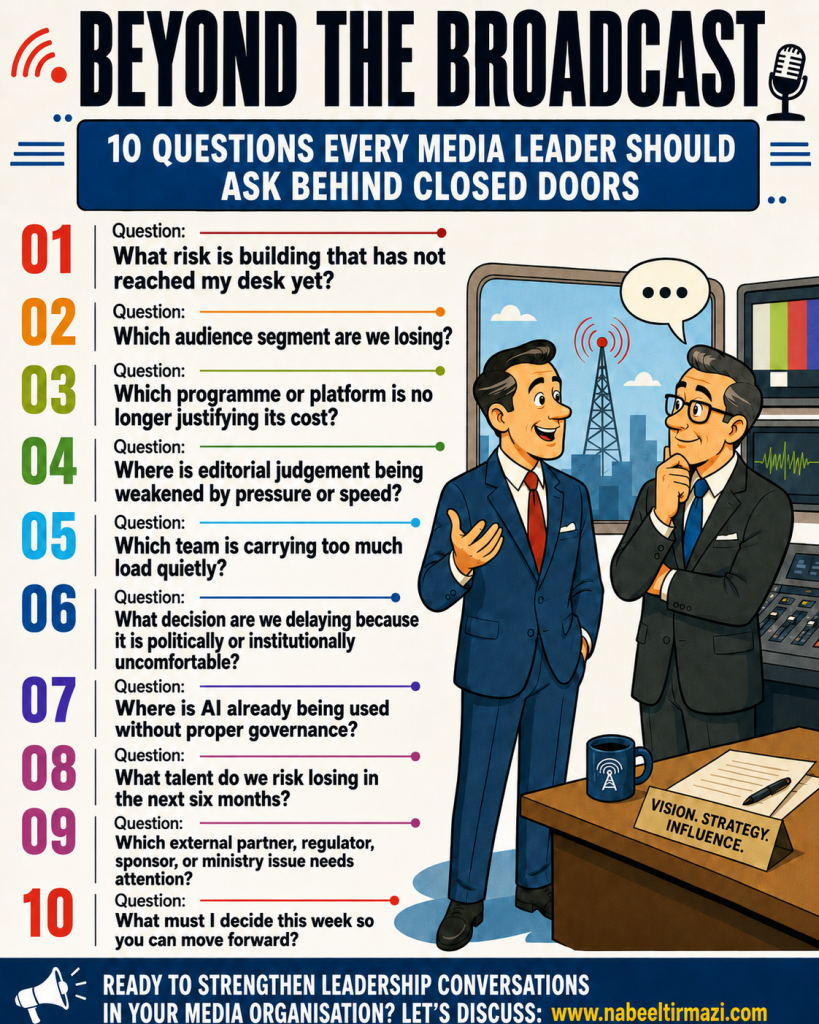
If you are leading a broadcasting or media organisation, I have created a short Media Leadership Risk Radar Score assessment to help you reflect on your organisation’s risk readiness. It is designed as a private self-check. Your score remains on your end, and the purpose is reflection, not data collection.
The reason for creating this assessment is simple: the real pressure inside a broadcasting organisation is not always visible on screen.
A bulletin may go on air smoothly while editorial judgement is under strain. A programme may still attract attention while its cost no longer makes sense. A digital platform may look active while a key audience segment is quietly leaving. From the outside, the organisation may appear functional. Inside, weak signals may already be building.
This is where senior leadership conversations matter.
In many organisations, 1:1 meetings are treated as routine staff updates. Someone reports what has been done, what is pending, and what needs approval. That has value, but for media leaders, it is not enough. A serious leadership 1:1 should work as an early warning system.
Broadcasting carries a different kind of pressure. It deals with public trust, editorial accountability, political sensitivity, audience behaviour, technology shifts, commercial realities, and now AI governance. These pressures do not always arrive as major crises. They usually begin as small signs: a hesitant editor, a tired production team, a delayed decision, a sponsor concern, a quiet audience drop, or an AI tool being used without clear rules.
Senior leaders need spaces where these signals can surface before they become public problems.
Here are 10 questions every senior broadcasting and media leader should be asking behind closed doors:
What risk is building that has not reached my desk yet?
Which audience segment are we losing?
Which programme or platform is no longer justifying its cost?
Where is editorial judgement being weakened by pressure or speed?
Which team is carrying too much load quietly?
What decision are we delaying because it is politically or institutionally uncomfortable?
Where is AI already being used without proper governance?
What talent do we risk losing in the next six months?
Which external partner, regulator, sponsor, or ministry issue needs attention?
What must I decide this week so you can move forward?
These questions are not meant to create fear. They are meant to create visibility.
The strongest media leaders do not wait for problems to appear in ratings reports, public complaints, newsroom disputes, or social media backlash. They build a culture where people can speak honestly before the damage is done.
This matters even more in the current media environment. AI is entering newsrooms, production workflows, archives, captioning, translation, audience analytics, and visual content creation. Audience loyalty is more fragile. Trust is harder to protect. Staff are expected to deliver across more platforms with fewer resources. External pressure can come from regulators, ministries, sponsors, platforms, or public criticism.
In such an environment, leadership cannot rely only on dashboards and formal reports. Dashboards show what has already been measured. Reports often arrive after the pressure has matured. Honest 1:1 conversations can reveal what is still hidden.
Broadcast leadership today is about more than airtime, budgets, ratings, and output. It is about protecting public trust, reading institutional pressure early, and making decisions before silence becomes costly.
The question for media leaders is simple:
Are your leadership conversations revealing risk early enough?
Take the Media Leadership Risk Radar Score assessment and reflect on how ready your organisation is to detect risk before it reaches the audience.
Assessment link: Risk Radar Quiz